
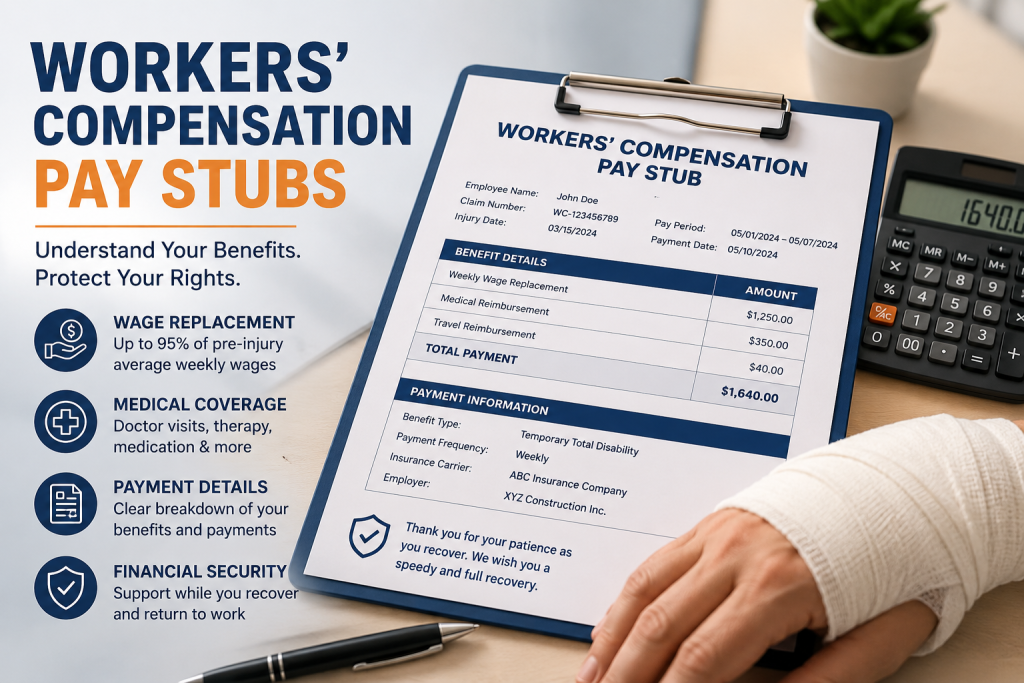
Workers’ compensation pay stubs are essential financial records that document wage replacement benefits paid to employees who suffer work-related injuries or illnesses. These statements help injured workers track compensation payments, medical reimbursements, and claim-related deductions while they recover and transition back to work.
Whether you are recovering from a workplace accident, repetitive strain injury, or occupational illness, understanding your workers’ compensation pay stubs can help you monitor your benefits, verify payment accuracy, and protect your legal rights. Compensation benefits can provide up to 95% of an employee’s pre-injury average weekly wages, depending on the jurisdiction and claim type.
What Is a Workers’ Compensation Pay Stub?
A workers’ compensation pay stub — sometimes called a payment statement or benefits statement — is a document issued by an insurance company, employer, or workers’ compensation administrator showing the payments made to an injured employee.
Unlike regular payroll checks, workers’ compensation payments are designed to replace income lost due to a work-related injury or illness. These benefits may also include medical treatment coverage, rehabilitation support, and travel reimbursements related to recovery.
Workers’ compensation payments generally do not come directly from your employer’s payroll system. Instead, they are typically paid through the employer’s workers’ compensation insurance provider.
What Information Appears on a Workers’ Compensation Pay Stub?
A typical workers’ compensation payment statement may include:
- Employee name and claim number
- Employer name and insurance carrier
- Injury or illness date
- Weekly compensation amount
- Payment frequency
- Benefit type
- Coverage period
- Medical reimbursement details
- Adjustments or deductions
- Remaining benefit balance
The uploaded documentation also notes that workers’ compensation records should clearly display:
- The date of injury or illness
- The amount and effective date of payments
- Payment increases or decreases
- Whether benefits are temporary or permanent
- Payment frequency (weekly, bi-weekly, monthly, etc.)
- Employer and insurer information
How Workers’ Compensation Payments Work
Workers’ compensation systems are designed to provide financial protection when employees cannot work because of job-related injuries.
The insurance carrier evaluates the claim and determines whether the injury qualifies for benefits. If approved, the injured employee may receive:
- Wage replacement payments
- Medical expense coverage
- Rehabilitation services
- Return-to-work support
- Permanent impairment compensation
The reference materials explain that compensation benefits may cover:
- Doctor visits
- Physiotherapy
- Prescription medications
- Imaging tests
- Joint injections
- Surgical procedures
- Rehabilitation programs
Do Workers’ Compensation Benefits Come Out of Your Paycheck?
One of the most common misconceptions is that workers’ compensation benefits reduce an employee’s paycheck directly.
In reality, workers’ compensation benefits are usually paid by the employer’s insurance provider — not deducted from the employee’s wages.
However, your overall income may temporarily decrease if:
- You are unable to work full-time
- You are placed on reduced duties
- Your employer offers lower-paying transitional work
- Your medical restrictions limit your hours
The injury itself may reduce your earning capacity, but workers’ compensation benefits are intended to offset part of that lost income.
Types of Workers’ Compensation Benefits
Temporary Total Disability (TTD)
These payments apply when an employee cannot work at all during recovery.
Typical features include:
- Weekly income replacement
- Coverage for temporary recovery periods
- Payments based on pre-injury wages
Temporary Partial Disability (TPD)
These benefits apply when the injured worker can still work in a limited capacity but earns less than before the injury.
Permanent Partial Disability (PPD)
Employees with long-term physical impairment may receive lump-sum compensation or ongoing payments.
Permanent Total Disability (PTD)
Workers with catastrophic injuries preventing future employment may receive long-term or lifetime benefits.
Common Workplace Injuries Leading to Compensation Claims
Workers’ compensation claims can arise from many occupational injuries and illnesses, including:
- Back injuries
- Repetitive strain injuries
- Knee injuries
- Shoulder injuries
- Carpal tunnel syndrome
- Slip-and-fall accidents
- Construction accidents
- Machinery injuries
- Occupational illnesses
- Bursitis
Understanding Wage Replacement Calculations
Most workers’ compensation systems calculate benefits using the employee’s average weekly wage before the injury.
Compensation rates often range between:
- 60% to 95% of pre-injury earnings
- Subject to state or jurisdictional maximums
- Adjusted according to disability classification
Medical Benefits Included in Workers’ Compensation
Workers’ compensation benefits frequently cover medical costs related to workplace injuries.
Covered expenses may include:
- Emergency treatment
- Specialist consultations
- Diagnostic imaging
- Physical therapy
- Chiropractic care
- Prescription medications
- Surgery
- Rehabilitation equipment
Many compensation pay stubs include separate sections for medical reimbursements and approved treatment costs.
How to File a Workers’ Compensation Claim
If you suffer a work-related injury, follow these steps immediately:
1. Report the Injury
Notify your employer as soon as possible after the accident or diagnosis.
2. Seek Medical Treatment
Visit a doctor for diagnosis and treatment documentation.
The uploaded materials emphasize that medical evidence plays a critical role in claim approval.
3. Complete Claim Forms
Submit all required workers’ compensation paperwork accurately and promptly.
4. Gather Supporting Documents
Important records include:
- Medical reports
- Imaging results
- Work restrictions
- Incident reports
- Payment statements
- Employer correspondence
5. Track Your Payment Statements
Keep copies of all workers’ compensation pay stubs and benefit notices for tax, legal, and financial purposes.
What to Do if Your Payments Are Incorrect
If your workers’ compensation pay stubs contain errors:
- Contact the insurance adjuster
- Notify your HR department
- Request corrected documentation
- Compare payments against approved benefit rates
- Consult a workers’ compensation attorney if necessary
Payment discrepancies can occur because of:
- Incorrect wage calculations
- Missing medical certifications
- Claim processing delays
- Administrative errors
Can You Receive Workers’ Compensation and Other Benefits Together?
In some situations, injured workers may qualify for multiple benefits simultaneously, including:
- Workers’ compensation
- Disability insurance
- Social Security Disability benefits
- Total and Permanent Disability (TPD) insurance
- Employer-sponsored disability programs
Why Workers’ Compensation Pay Stubs Matter
Workers’ compensation payment statements are more than simple financial records. They serve as critical proof of:
- Active benefits
- Income replacement history
- Claim status
- Medical coverage
- Legal entitlement
- Insurance payment history
These documents may also be required when applying for:
- Social Security benefits
- Mortgage applications
- Disability claims
- Legal appeals
- Settlement negotiations
Final Thoughts
Workers’ compensation pay stubs play a vital role in helping injured employees manage their financial recovery after workplace injuries. From wage replacement and medical reimbursements to permanent disability compensation, these statements provide transparency and accountability throughout the claims process. Understanding how workers’ compensation payments work can help employees protect their rights, monitor their benefits, and ensure they receive the compensation they deserve while recovering from a work-related injury or illness. For workers navigating complex claims, maintaining accurate records, reviewing payment statements regularly, and seeking professional guidance when needed can significantly improve the overall compensation experience.
Frequently Asked Questions (FAQs)
1. What is a workers’ compensation pay stub?
A workers’ compensation pay stub is a payment statement that documents benefits paid to an injured employee for lost wages and approved medical expenses after a workplace injury.
2. Who issues workers’ compensation payments?
Workers’ compensation payments are usually issued by the employer’s insurance company or workers’ compensation administrator, not directly by the employer.
3. How much do workers’ compensation benefits pay?
Benefits typically replace a percentage of your average weekly wage, sometimes up to 95%, depending on the state, country, or claim type.
4. What information appears on a workers’ compensation pay stub?
Most payment statements include:
- Claim number
- Injury date
- Weekly payment amount
- Payment type
- Employer information
- Insurance carrier details
- Payment frequency
- Medical reimbursements
5. Do workers’ compensation benefits come out of my paycheck?
No. Workers’ compensation benefits are generally paid by the employer’s insurance provider and are not deducted from your paycheck.
6. Why is my paycheck lower while on workers’ compensation?
Your earnings may decrease if you are unable to work full-time or are placed on restricted duties with reduced hours or lower wages.
7. Are workers’ compensation payments taxable?
In many cases, workers’ compensation benefits are not taxable under federal law, though tax rules can vary by jurisdiction.
8. How often are workers’ compensation payments made?
Payments are commonly issued weekly or bi-weekly, depending on the workers’ compensation system and insurance carrier.
9. What medical expenses are covered under workers’ compensation?
Coverage may include:
- Doctor visits
- Physical therapy
- Prescription medications
- Diagnostic imaging
- Surgery
- Rehabilitation services
10. Can I receive workers’ compensation and disability benefits together?
Yes. Some workers may qualify for additional disability or TPD benefits alongside workers’ compensation payments.
11. What should I do if my workers’ compensation pay stub is incorrect?
You should immediately contact the insurance adjuster, HR department, or claims administrator to request a correction.
12. How long do workers’ compensation payments last?
The duration depends on the severity of the injury, the medical recovery timeline, and whether the disability is temporary or permanent.
13. What happens if my workers’ compensation claim is denied?
You may have the right to appeal the decision, provide additional medical evidence, or seek legal assistance.
14. Why should I keep copies of my workers’ compensation pay stubs?
These documents may be needed for:
- Legal claims
- Tax records
- Disability applications
- Settlement negotiations
- Financial verification
15. Can repetitive strain injuries qualify for workers’ compensation?
Yes. Conditions like bursitis, carpal tunnel syndrome, and chronic joint injuries caused by repetitive work tasks may qualify for compensation benefits.

